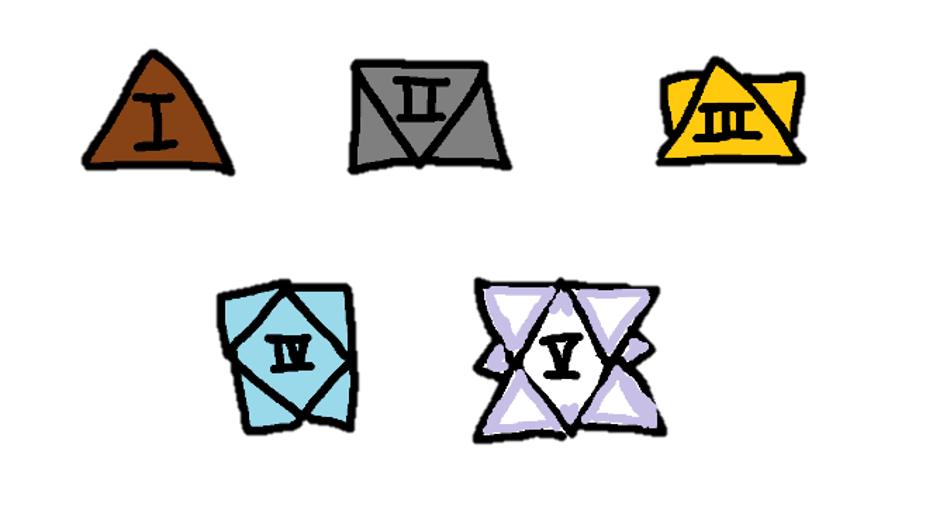
What are Tiers of Mastery?
Most Channelers never leave Novice.
This is not a tragedy. A Novice Channeler is capable of deeds that would seem impossible to someone who has never touched Prisma at all – likely going on adventures and learning much about themselves in the process. A Novice Channeler can be a hero of their town, or an Artificer with a very profitable workshop – leading a content life with a very useful and rewarding skillset.
But the type of Channelers who shape History – the Legendary casters and warriors who form kingdoms and challenge Gods – walk a long, arduous path that most do not see the end of.
This journey is one as old as time, and as it is well-trodden over the aeons, society at large has recognized Five Distinct Tiers of Prismatic Mastery across Channelers.
These Tiers of Progression all immediately signal the prestige and power of a given Channeler, and Guilds exist to officiate and document this progress among recognized Channelers, with a robust network across the world.
Thanks to these efforts, a party of Channelers with Novice-Level badges can travel across a continent to a remote and foreign town, and its residents will understand immediately their prestige, power, and what they can offer them. This holds true across the spectrum: those who carry Paragon Designation are hailed as celebrities and heroes wherever they go. In a City Besieged by an Ancient Divine Dragon, it is common knowledge that the first thing to do is seek out a Channeler of this status – and pray they arrive in time.
Tiers describe Channelers first and foremost. Though, as Channelers are often on the frontlines against the world’s Creatures and Threats and mastering particular spells and weapons at predictable levels of mastery, many other things are “ranked” with this same system.
Hostile Creatures have Tiers corresponding with the level of Channeler that stands a chance against them. A Creature being classified as Tier II, or Journeyman-Level, requires at least a Journeyman-level Party to defeat on a level playing field.
A Tier I Novice-Level Party of Adventurers would be at a heavy disadvantage on a level playing field, and a Tier III+ Party would handle this creature with ease. This allows settlements to properly call in help and assign quests to properly equipped Channelers.
Weapons and Spells are Described by the tier of Mastery expected to properly wield them.
A Prismatic Spell is determined to be Journeyman-Level when the amount of Prisma required corresponds roughly to a Journeyman-Level Channeler’s expected output.
This is not a hard-and-fast rule, of course, and the designation also serves as a great heuristic for ascertaining the proficiencies of a particular Archetype and Channeler. A Novice Minstrel, for example, might have the skill to cast Journeyman-Level Charms thanks to being particularly talented at casting Charms. Inversely, this same Minstrel might graduate to Journeyman level and still rely on Novice-Level Evocations as a backup option.
Martial Abilities operate on a similar axis, but mundane weapons do not themselves carry a Tier Designation. Instead, Tiers are applied to Proficiencies and Techniques. A Novice and a Virtuoso Barbarian, then, both likely able to wield the same Battleaxe and use it to rout foes with no issues. The Virtuoso Barbarian, however, has Virtuoso-level Proficiency with the weapon - and thanks to mastery of the self and their corresponding Prisma, swings it with a much greater deal of potency and consistency, cleaving it through multiple foes at a time and cutting off limbs in the process. As with spellcasting, one with particular talent for a specific weapon might achieve a higher tier’s abilities earlier, and a mage wielding a dagger as a sidearm might swing it with Novice-Level abilities despite being a Channeler of the Master Tier.
What follows is a description of each Tier as recognized by the Guild — what they mean, what they demand, and what they promise to those who earn them.
The Tiers in Order
Novice Tier
The Novice Tier is the first step of every Channeler's journey. Denoted by a simple Copper Badge, Novice Channelers commit to a basic Archetype and begin learning the fundamentals of Prismatic Mastery.
Novices are the most plentiful Channelers in the world, of wildly varying aptitude, and carry the quiet prestige that comes simply from being a Channeler at all. They are the local do-gooders — the defenders of a small town, the apprentices of an established workshop — working toward the skill and reputation required to earn their next designation.
Novice-tier threats are common nuisances: the kind of danger a village can name and live alongside but not ignore indefinitely.
Link to original
Journeyman Tier
The Journeyman Tier is the first designation earned through demonstrable feats of skill and mastery. Denoted by a fine Silver Badge, Journeyman Channelers are considered capable and committed past the early stumbling of Novice work and actively refining their craft.
The Journeyman Tier serves to filter out the mediocre and noncommittal and is consequently far less common than Novice. Most settlements have a healthy but limited number of Channelers at this level - enough to be relied upon, not enough to be taken for granted. Journeyman designation carries real prestige: the mark of someone skilled and dependable, if not yet remarkable.
Journeyman-tier threats move beyond nuisance into genuine danger, putting local livelihoods and safety at risk. These Channelers are working toward becoming the hero a town remembers or building a name for themselves in the wider world.
Link to original
Adept Tier
The Adept Tier is the second designation earned through demonstrable feats of skill and mastery - and the first that cannot be reached by talent and determination alone. Denoted by a beautifully crafted golden badge, individually serialized and registered with the Guild, no two are quite alike. An Adept Badge is immediately recognizable as something earned rather than bestowed, and those who wear one have faced trials that most Journeymen never survive intact.
The Adept Tier is a major threshold in a Channeler’s journey, achieved only by a fraction of Journeymen who possess not merely the ambition to push further, but the rare combination of skill, resilience, and mastery to actually arrive. Most settlements hold their Adept Channelers in deep regard - treating them as pillars of their communities - sought after as mentors, leaders, and authorities in battle, craftsmanship, and scholarship alike.
For most ambitious Channelers, Adept is where the journey ends — and it is no small thing. Those who reach this tier and choose to remain have lived full and remarkable lives by any measure. The gap between Adept and what lies beyond is wider than any crossed before it: a reminder that the path does not simply continue, it steepens.
The Adept Tier is where most ambitious Channelers terminate their journey, and those who stay at this level are considered to have had a robust, successful journey across their lives. The gap of skill between this tier and the next is far greater than those previous.
Adept-tier threats are urgent and threaten entire settlements or large pieces of infrastructure. These Channelers are working toward becoming a local legend or bolstering their already glowing reputation in the wider world.
Link to original
Virtuoso Tier
The Virtuoso Tier is the first designation that graduates a Channeler from local recognition to a chapter in a History Book. This designation's badge is unlike any other - crafted with gemstone hues unique to the bearer's craft and character, richly inscribed in a design that could belong to no one else. Guilds across the world maintain records of every living Virtuoso, and the list is never long.
Achieving Virtuoso designation is considered a profound honor, obtained only through acts of remarkable heroism and skill that strain the boundaries of what most believe possible. Small settlements rarely count a Virtuoso among their residents - and those that do consider themselves extraordinarily fortunate. Where a Virtuoso lives, they lead: as head of the guard, headmaster of a university, or simply the person a community turns to when nothing else will suffice. They are local legends who bring prestige to a place by the simple fact of calling it home.
Reaching the Virtuoso Tier is widely regarded as the mark of a life genuinely well-lived - a destination most Channelers would be honored to call their own. The gap between this tier and the next is vast and largely uncharted, requiring not just exceptional skill but the kind of generational talent that appears perhaps once in an age.
Virtuoso-tier threats are rare and severe - the kind that topple governments and leave scars on the land itself. Facing one without Virtuoso-level capability is considered deeply reckless. These Channelers work toward the rarest of distinctions: a name known not just across the world, but across generations.
Link to original
Paragon Tier
The Paragon Tier is the highest designation among Channelers — the mark of a truly generational name, known not just across the world but across time. Paragon Badges are small vessels forged from cosmic materials, carrying exceedingly rare Prisma that borders on pure Prima, tinted only by the faintest hue of the bearer's own soul. No Guild registry tracks them. No introduction is required. The name arrives before the person does.
Paragon Channelers serve as the platonic ideal of their Archetype — so completely that their unique journey and relationship with Prisma often forms the foundation of the spellbooks and fighting styles practiced by aspiring Channelers for generations after. Each Archetype is associated with at least one Paragon whose path became the map others follow.
Paragons tend to reside in one of two places: the most prestigious and powerful kingdoms in the world, which court them as living symbols of national identity — or small, unremarkable villages that find themselves suddenly and permanently on the map as the birthplace of a legend. The distance between Virtuoso and Paragon is not a gap so much as a threshold of a different kind entirely. Most continents count their living Paragons on one hand.
Paragon-tier threats are named. They are the kind that do not merely endanger settlements or reshape regions, but they threaten the continuity of the age itself, and their defeat or containment becomes the event that future generations use to mark time. These Channelers tend to conclude their journey not with a personal achievement, but a civilizational one: a new fighting style that rewrites how a weapon is understood, a category of spells that didn’t exist before they imagined it, or a technology that permanently changes what the world believes is possible.
Link to original